Why rental car choice is not purely rational
On the surface, selecting a rental car looks like a simple cost-and-size decision: pick the cheapest suitable vehicle and move on. In reality, the process is shaped by a mix of psychological biases, perceived risk, identity expression, and situational anxiety.
Even when options are functionally similar, people consistently gravitate toward specific categories of vehicles based on how they want to feel during the trip rather than strictly what they need.
This makes rental car selection a useful case study in applied behavioral economics.
The illusion of control and vehicle size bias
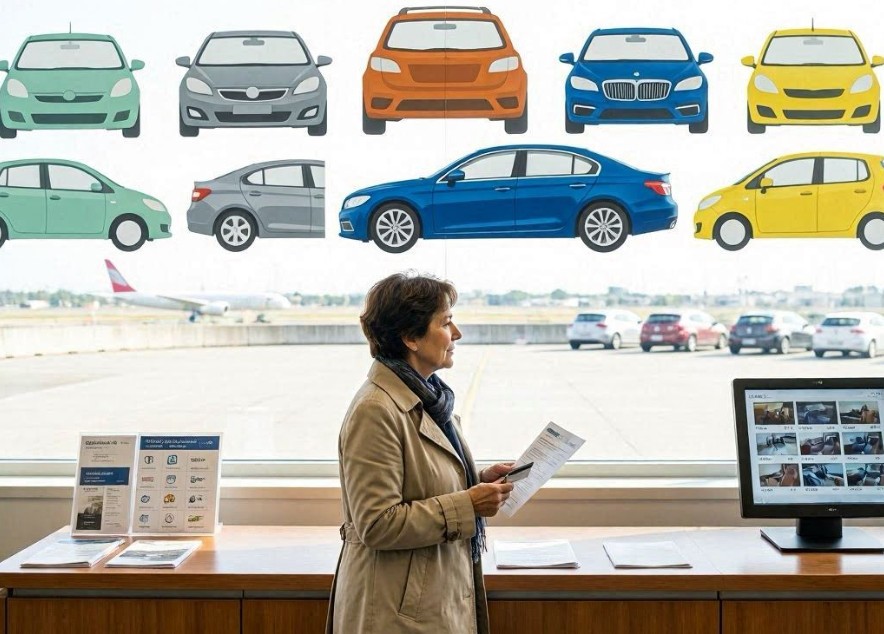
One of the strongest drivers in rental decisions is the desire for perceived control. Larger vehicles—such as SUVs or crossovers—are frequently chosen even when not strictly necessary for luggage or passengers.
This preference is not always about utility. It is often about psychological safety: a larger car feels more stable, safer, and more capable of handling unknown conditions.
Common manifestations
- Choosing SUVs for city trips where compact cars would suffice
- Overestimating luggage needs “just in case”
- Preferring higher seating positions for visibility and confidence
Risk perception and travel context
Rental car decisions are heavily influenced by perceived environmental risk. Travelers adjust their choices based on destination unfamiliarity, driving conditions, and expected infrastructure quality.
For example, someone traveling to an unfamiliar country or rural region is more likely to choose a robust or higher-clearance vehicle than they would at home.
This reflects a cognitive shortcut: when uncertainty increases, people tend to overcompensate with perceived durability.
Status signaling and vehicle category selection
Rental cars also function as temporary identity signals. Even though the vehicle is not owned, it still projects an image to travel companions, colleagues, or locals.
This leads to subtle status-driven decisions, such as upgrading to premium or luxury categories even when unnecessary from a practical standpoint.
Typical status-driven behaviors
- Upgrading to premium sedans for business trips
- Choosing newer models over older but cheaper options
- Prioritizing brand perception over functional equivalence
The role of cognitive overload in booking decisions
Rental platforms often present dozens of vehicle options with varying prices, insurance packages, and specifications. This creates cognitive overload, which leads users to rely on heuristics rather than detailed comparisons.
As a result, many travelers default to familiar categories or “recommended” options rather than analyzing each variable independently.
This simplification reduces decision fatigue but can also lead to suboptimal choices.

Loss aversion and insurance add-ons
One of the most consistent psychological patterns in rental behavior is loss aversion—the tendency to strongly prefer avoiding losses over acquiring equivalent gains.
This is most visible in insurance decisions. Even when the probability of damage is low, many travelers opt for full coverage to avoid the emotional discomfort of potential unexpected costs.
Behavioral outcome
- High uptake of collision damage waivers
- Preference for “zero liability” options
- Overestimation of accident probability in unfamiliar environments
Anchoring effects in pricing perception
Rental car pricing systems often present a “base price” followed by incremental upgrades. The first price seen acts as an anchor, influencing how all subsequent options are perceived.
Even when upgrades are objectively expensive, they can feel reasonable when compared to a high initial reference point.
This mechanism is a classic example of anchoring bias in consumer behavior.
The comfort-maximization heuristic
Many travelers unconsciously follow a simple rule: maximize comfort within budget constraints. However, “comfort” is interpreted broadly and often includes psychological comfort rather than physical features alone.
This includes factors such as driving ease, familiarity with vehicle type, and perceived reliability.
Comfort factors beyond seating
- Ease of navigation and control layout
- Brand familiarity and trust
- Smoothness of acceleration and braking
- Noise insulation and ride quality perception
Influence of travel companions
Rental car decisions are rarely made in isolation. Group dynamics strongly influence final choices, especially in family or business travel.
In many cases, the final decision reflects compromise rather than individual preference, with safety and space concerns often outweighing cost efficiency.
Interestingly, the most vocal traveler in a group is not always the primary decision-maker, but often shapes the perceived acceptable range of options.
Time pressure and default selection behavior
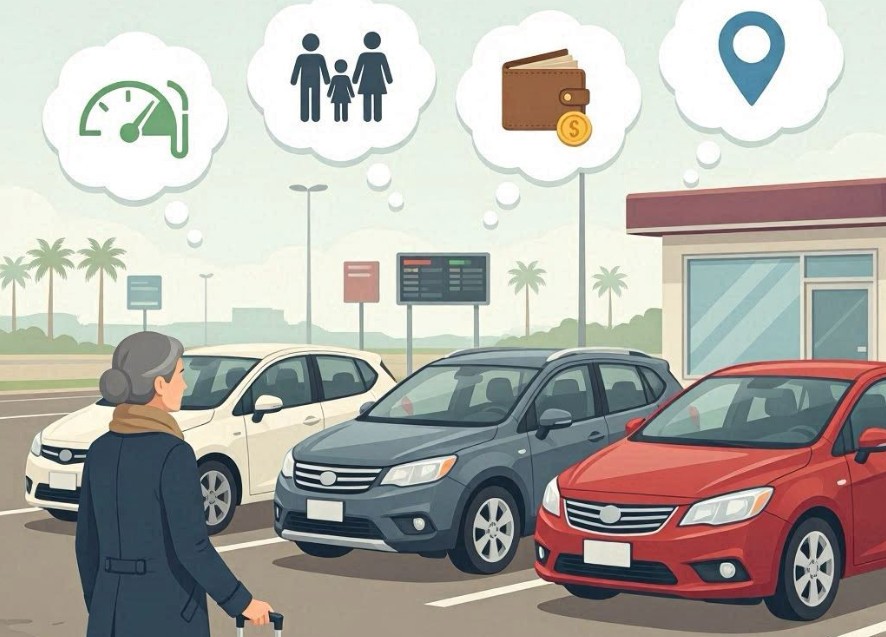
When bookings are made under time pressure—such as last-minute travel—users are more likely to accept default or recommended options without extensive comparison.
This increases reliance on platform algorithms and “best value” labels, which act as decision shortcuts.
Under time constraints, minimizing mental effort becomes more important than optimizing value.
Emotional framing of the trip
The intended emotional tone of the trip also affects vehicle choice. A leisure vacation may encourage more expressive or comfortable vehicle selection, while a business trip may favor efficiency and formality.
In this sense, the rental car becomes part of the emotional architecture of the journey.
Conclusion: a decision shaped by mind, not just money
Choosing a rental car is rarely a purely economic decision. It is shaped by psychological biases, emotional expectations, perceived risk, and social context.
While price and practicality remain important, the final choice often reflects how travelers want to feel during their journey—secure, comfortable, capable, or elevated.
Understanding these patterns helps explain why people sometimes choose vehicles that exceed their practical needs, and why rental decisions are as much about psychology as transportation.
